Understanding San Diego C&D Debris Recycling Regulations for General Contractors
Construction and demolition debris is one of the most heavily regulated waste streams in San Diego County. The city's mandatory recycling ordinance requires that a minimum of 65% of all C&D debris generated by covered projects be diverted from landfill disposal. For general contractors, this is not a suggestion — it is a legal obligation tied to your permit and final inspection sign-off.
Covered projects under the San Diego C&D ordinance include new construction, remodels over a certain square footage, and full demolition of load-bearing structures. The threshold varies by jurisdiction, but in the city of San Diego, any project that requires a building permit and generates more than a nominal amount of debris typically falls under the rule. If you are pulling a permit, you are almost certainly on the hook for diversion documentation.
The diversion requirement applies to a specific list of materials: concrete, asphalt, wood, metals, cardboard, gypsum board, and clean fill soil. These are the materials that San Diego County recycling facilities are equipped to accept and process. Mixed debris loads that are simply dumped at a landfill without sorting do not count toward your diversion percentage, and a load that is not sorted will drag your compliance numbers down.
Documentation is where most contractors get tripped up. You must obtain weight tickets from a permitted C&D processing facility for every load hauled away from the site. These weight tickets must show the facility name, date, material type, and tonnage. At the end of the project, you submit a final recycling report to the city that totals all the tonnage hauled, the tonnage diverted, and the resulting diversion percentage.
If your diversion percentage falls below the required threshold, you face penalties. The city can withhold your final inspection, refuse to close out the permit, and in some cases issue fines. More importantly, a project that cannot close out its permit creates a cascade of delays for the property owner, the lender, and the next phase of construction. Compliance is not just about avoiding fines — it is about keeping the project timeline intact.
A common mistake is assuming that the hauling company handles all the compliance paperwork. In reality, the responsibility for the final recycling report falls on the contractor or the property owner of record. The hauler provides the weight tickets, but someone has to compile them, calculate the percentages, and submit the report in the correct format. Many contractors do not realize this until the final inspection is delayed.
This is where choosing the right hauling partner matters. A hauler who is permitted at San Diego County C&D processing facilities will generate the correct weight tickets automatically. A hauler who simply dumps everything at the nearest landfill will hand you a stack of tickets that show zero diversion, leaving you to explain to the city why your project failed to meet the 65% threshold.
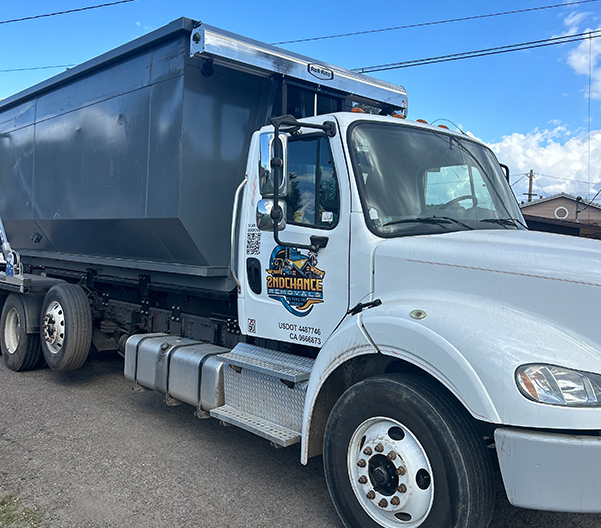
2nd Chance Removals operates as a permitted hauler at multiple C&D processing facilities across San Diego County. Every load we haul generates a weight ticket that shows the material type and tonnage, and we provide those tickets to the contractor in an organized format. We do not dump mixed loads at a landfill and call it a day — we sort, we divert, and we document.
For contractors working in East County communities like Santee, El Cajon, and La Mesa, the logistics are straightforward. We can coordinate same-day hauling from your site to a permitted facility, which means your weight tickets are available within hours of the load leaving the site. This is critical for projects on tight timelines where you cannot afford to wait days for documentation to trickle in.
The other piece of the compliance puzzle is pre-project planning. Before the first wall comes down, you should have a waste management plan that identifies which materials will be diverted and which facility will accept them. The city does not require a formal written plan for every project, but having one prevents the last-minute scramble when you realize half your debris is mixed and unsortable.
If you are a general contractor in San Diego County and you have questions about C&D compliance, or if you need a hauling partner who can generate the documentation your project requires, call our dispatch line. We work with contractors every day who need compliant hauling, not just someone with a truck and a low price.
Need Hauling for Your Project?
We provide legal, on-demand junk removal, dumpster rentals, light demolition, and recycling services across San Diego County. Call our dispatch line for same-day service and compliant documentation.
Related Articles
How to Create a Construction Site Waste Management Plan
A waste management plan is not just paperwork. It is a practical tool that keeps your project compliant, on budget, and on schedule. Here is how to build one.
Read More
Assisted Self-Hauling vs Traditional Junk Removal: What Contractors Need to Know
Municipal codes define commercial junk hauling as 'Assisted Self-Hauling.' Learn how this model offers contractors greater pricing flexibility, legal security, and documentation control.
Read More
How to Estimate Dumpster Sizes for Kitchen and Bathroom Remodels
A practical guide to selecting the right container size for residential tile, cabinetry, and drywall teardowns to prevent weight overage fees and job site clutter.
Read More